Mad Barn Review: My Horse’s Diet Evaluation and Supplement Results
I help the Mad Barn team write educational content as part of my freelance work, but I’ve purchased and fed their supplements myself for years. This review reflects my own experience and independent research, including instances where I opt for other brands instead.
Equine supplement companies are good at making claims. Fewer of them are good at backing up those claims.
While I’d love for every new product that shows up in my newsfeed claiming to magically transform my horse into a unicorn to actually work, I’m a skeptic. I work in marketing after all.
Mad Barn is one of the most popular equine supplement brands that offers products supported by real science. All it takes is a visit to their website to see how much they've invested in educating horse owners and advancing equine research.
But as an actual horse owner and competitive rider, I also know that studies and citations only go so far. When it comes to feed and supplements, what really matters is the results you see in your horse.
That’s why I decided to put my horse’s supplement program to the test, starting with a full diet evaluation by one of Mad Barn’s PhD equine nutritionists. I’ve fed their products for years, but I wanted to see if their recommendations and swaps actually made a difference.
Here's what the evaluation involved, why the nutritionist recommended AminoTrace+ over the ration balancer I'd been feeding, the science behind each product now in my horse's program, and where I still reach for a different brand.
My Horse's Background and Feeding Program
My horse is an 8-year-old Dutch Warmblood gelding in full-time dressage training who lives outside 24/7 in Northern Virginia during the summer. I’ve owned him his entire life.
He's sensitive and energetic, with a tendency to carry tension in his muscles. Unfortunately, for my wallet and sanity, he has a history of self-inflicted injuries and some ugly X-rays. A balanced diet and extra support are non-negotiable.
While living outside is ideal for his mental and physical health, full-time turnout comes with management challenges. His black coat bleaches in the sun every summer, and he has sensitive skin prone to bug-bite reactions and hives.
Given his unique needs, I wanted a nutritionist to look at the whole picture of his diet rather than guessing my way through individual products and wasting money in the process.
And yes, of course, he also sees his veterinarian, farrier, and bodyworkers on a regular schedule. Nutrition is one piece of his health and performance program, not a replacement for the rest. Without good basic management, supplements won’t do anything.
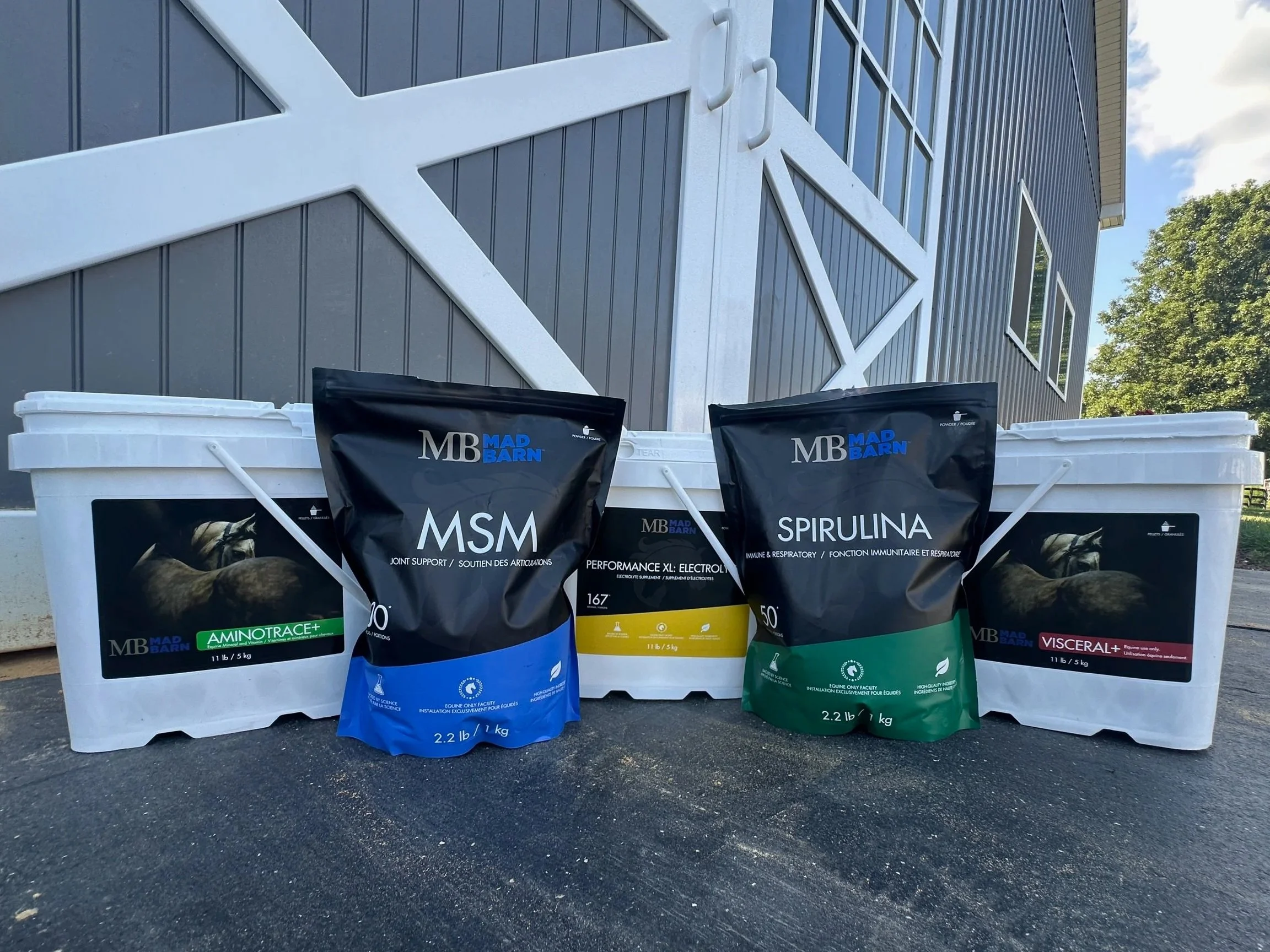
Here's what he was eating before the consultation, and the new recommended Mad Barn products we tried:
Forage-Based Diet:
Free-choice Mixed Grass Hay
Triple Crown Stress Free Chopped Forage
Standlee Alfalfa Pellets (Soaked)
Renew Gold
Chia Seeds
Supplements:
Mad Barn Omneity Premix
Mad Barn Visceral+
KER EO-3 Oil
KER Nano-E
Cosequin ASU+
Salt
Recommended Mad Barn Products:
Mad Barn AminoTrace+
Mad Barn Performance XL Electrolytes
Mad Barn Spirulina
Another addition I made to his feeding program after some supplement swaps is turmeric. I know, I know. This is all looking very crunchy with the chia and the spirulina and the turmeric. But it’s not for the reasons you may expect. I promise I’ll explain more later on.
When I write it all out, it seems like a lot. But every product has a purpose. So I pre-portion every supplement into individual containers for each feeding to make life easier for the barn staff. As a former professional groom and working student, I know how time-consuming it is to scoop all those supplements. And how important it is to stay on the barn staff’s good side.
My Experience With Mad Barn
Every horse owner knows how overwhelming shopping for horse supplements can be. Planning a feeding program for your horse is one of the most important aspects of horse ownership. But it’s hard to do alone.
When I worked in high-performance barns, we had direct access to some of the best nutritionists in the country, who worked one-on-one with us to develop completely customized feeding programs for the elite equine athletes we managed.
I figured that type of support was completely inaccessible for my own personal horse and me. That is, until I stumbled upon Mad Barn after years of my own research and trying countless products without much guidance.
Mad Barn offered free diet evaluations and consultations. But were they actually helpful, or just marketing? I decided to find out.
Mad Barn Equine Nutritionists
Lots of equine supplement brands work with and employ equine nutritionists. But I can’t think of any brand with more qualified nutritionists and veterinarians on their team than Mad Barn.
Why exactly do they need that army of PhDs and DVMs? Because their jobs aren’t just to formulate new products. Mad Barn makes their nutritionists available directly to horse owners to provide education and support that make it easier to feed your horse what they need.
In addition to contributing to their educational platform, Mad Barn Academy, the Mad Barn nutritionists also offer free diet evaluations and nutrition consultations.
Free Mad Barn Tools
There are several tools on the Mad Barn website that horse owners can use on their own to make informed decisions about more than just their horse’s nutrition.
These tools include:
Equine Feed Database: Browse thousands of horse feeds, supplements, forages, and ingredients to review product labels and compare nutritional profiles.
Equine Heat Index Tool: Check the real-time heat index for your location to monitor for heat stress risks.
Equine Air Quality Index: Get real-time air quality updates for your location to monitor pollution risks.
Equine Electrolyte Calculator: Estimate your horse's sweat volume and electrolyte losses during exercise to provide appropriate hydration and support post-workout recovery.
Horse Nutrition Calculator
The most useful tool on the Mad Barn website for evaluating and planning your feeding program is the Horse Nutrition Calculator.
You can use the nutrition calculator to input your horse’s current feed and supplements and calculate nutrient requirements to determine if their diet is meeting their needs. The calculator is based on the current information in their feed database, so there may be gaps where the exact guaranteed analysis of certain feeds is unknown, but it is extremely helpful.
This tool is very similar to FeedXL, which I love and have used in the past. While Premium FeedXL plans offer slightly more comprehensive insights, including mineral and omega ratios, you have to pay for it. The Mad Barn nutrition calculator is free.
You don’t even have to hand over your email address to see the nutrition of your horse’s current diet. And if you can’t be bothered to interact with another person, you can play with the calculator on your own to see the impact of adding and replacing products.
Mad Barn Diet Evaluation
You also have the option to submit your horse’s diet for a Personalized Diet Evaluation by a Mad Barn nutritionist.
To request a diet evaluation, you’ll submit:
Your horse’s name (and an optional photo; everyone appreciates cute pony pictures)
Your contact information so their team can reach you
Your horse’s gender, age, weight, and body condition
Your horse’s breed, physiological status, exercise level, and ZIP code location
Any special care needs to consider (digestion, hoof, joint, respiratory issues, etc.)
Their current feed and supplement program and daily intake
Any questions, comments, or additional information you want to provide
After submitting the diet evaluation request, you’ll get a response from a nutritionist by email with an overall evaluation, suggestions, and answers to any questions. I’ve typically heard back within 48-72 hours of submission.
I haven’t received a detailed report of nutrient levels in my diet evaluations, just insights and recommendations from the nutritionist. So if you like to dig into the hard data yourself, I recommend using the horse nutrition calculator before (and after, if they recommend changes) submitting your diet for evaluation.
Booking a Nutrition Consultation
Mad Barn also offers Free Nutrition Consultations over the phone with a qualified equine nutritionist.
Horse owners can schedule a free call by booking an appointment time on their website page, linked above. You can even request a specific nutritionist.
They recommend submitting your horse’s diet for evaluation ahead of time for the best results. But if you’re overwhelmed by entering every feed and supplement on the evaluation submission form, you also have the option to share that information over the phone.
Appointments are 30 minutes long, available Monday through Friday, and you can book up to a month in advance.
I haven’t booked a nutrition consultation myself, but mostly because my diet evaluation experience was so thorough I didn’t have any questions left. Plus, I think best in writing and tend to yap on the phone, so I’ve spared the nutritionists from said yapping for now.
My Horse’s Diet Evaluation
I’ve submitted my horse’s diet for an evaluation twice, during very different periods in his life, looking for help with specific challenges.
Both times the Mad Barn nutritionists were incredibly helpful and saved me a great deal of time and headache with their insights.
Most surprisingly, they didn’t push Mad Barn products at all and even recommended keeping certain supplements that I like from their competitors in my horse’s program. They only ever suggested trying Mad Barn supplements when I specifically asked for recommendations.
Rehabilitation and Healing
The first time I submitted my horse’s diet for an analysis was in 2022. I was in the middle of rehabbing my then 4-year-old from a collateral coffin ligament injury sustained from a field incident involving a misplaced step on a stray rock. Yay, horses.
That rock led to six months of tack walking, hours of supervised turnout, countless expensive treatments, and the type of vet bills that tempt horse owners to consider taking up less financially and emotionally taxing hobbies, like, I don’t know, competitive yacht racing.
Did I mention I was tack walking my four-year-old warmblood? What the heck was I supposed to feed him?
I submitted that first diet analysis with a long, long list of numbered questions. And I got a response from a veterinary nutritionist with thorough and helpful answers to every single one.
We survived tack walking, and my horse thrived on a forage-based diet without commercial high-starch grains. The nutritionist recommended using Mad Barn’s Omneity Premix as a ration balancer, which would ensure my horse got all of the nutrients he needed to support healing, without the excess energy he did not need.
They also recommended increasing gut support during the period of increased stress with Visceral+, which I’ve kept in my horse's feed program ever since.
Coat and Skin Health
Four years later, that gangly 4-year-old is now a grown-up dressage horse. Except he didn’t look like the shiny, fancy, pitch-black 8-year-old horses I was used to in dressage barns. Why? Because unlike most performance horses, he lived outside.
Look, I’m a big believer in the three Fs: Forage, Freedom, Friends. I’m very fortunate that in the summer in Northern Virginia, my horse can stay in full training and live outside 24/7 with friends. He’s happy, he’s healthy, and he doesn’t try to launch me into outer space after a weekend off (most of the time).
But during the summer, sun bleaching turns my beautiful black dressage horse into something that resembles a dusty feral buckskin. And this summer added a new challenge: hives.
I had done everything I could. I called my veterinarian the first time he broke out badly, but he couldn’t live on dex. We mowed his field. We tried fly sheets, fly masks, fly boots. He destroyed all of them. And the hives kept coming back.
Could nutrition help transform this scraggly dirt-colored and hive-covered gelding back into a beautiful, shiny, black, fancy dressage horse that could still thrive while living outside?
I turned back to Mad Barn. Their recommendations:
Increase the nutrients that support skin and coat health by swapping from Omneity to AminoTrace+
Replace electrolytes lost in sweat during the summer with Performance XL Electrolytes
Try Spirulina to support healthy skin and immune function for his seasonal allergies and skin sensitivities
So this summer, I gave those supplement swaps a try.
AminoTrace+ vs. Omneity
I'd been feeding Omneity Premix, Mad Barn's core vitamin and mineral ration balancer, before my latest diet evaluation. The nutritionist recommended switching to AminoTrace+.
AminoTrace+ provides higher levels of amino acids, copper, and zinc than Omneity, along with a lower-starch, lower-sugar profile built for horses with metabolic sensitivities.
My horse doesn’t have metabolic concerns, but increasing amino acids, copper, and zinc would all support his hair health and coat color. Our area has high iron levels in the hay and water, which can contribute to sun bleaching if the diet does not provide adequate copper and zinc.
At first, I was concerned that there was more phosphorus than calcium in the supplement. Horses need a 2:1 calcium to phosphorus ratio to support bone health. However, most horses get plenty of calcium from their diet, especially if, like my horse, their diet includes alfalfa.
When I checked the supplement swap with the Nutrition Calculator, I discovered AminoTrace+'s profile was actually the better match for what he was already getting from forage. Lesson learned: always start with a forage analysis.
Mad Barn Supplement Reviews
Here's my hands-on review of each Mad Barn product in my horse's program, including what it's designed to do, my experience feeding it, and practical notes for other horse owners considering it.
Mad Barn AminoTrace+ Review
AminoTrace+ is Mad Barn's enhanced, low-starch, low-sugar vitamin and mineral ration balancer, built for horses with metabolic concerns, elevated hoof and topline support needs, or diets that require concentrated nutrition without added sugar.
It provides organic trace minerals, essential amino acids, and 1250 IU of natural vitamin E per daily serving.
The levels of essential amino acids Lysine, Methionine, and Threonine in this formula are similar to standalone amino acid supplements. One serving contains 10 g Lysine, 6 g Methionine, and 5 g Threonine.
It contains significantly more zinc and copper than Omneity, providing 750 mg of zinc and 300 mg of copper per serving. Horses need these trace minerals in an ideal ratio to maintain hoof, skin, and coat health.
AminoTrace+ also provides elevated levels of Magnesium at 11 g per serving. Magnesium supports normal muscle function, metabolic health, and a balanced stress response.
The pelleted formula makes it easy to feed horses on forage-based diets as a replacement for other ration balancers. But it shouldn't be fed alongside other vitamin and mineral balancers, since that can create nutrient redundancy.
AminoTrace+ is best for horses with insulin resistance, PPID, high dietary iron, or those needing a more concentrated amino acid and mineral profile than a standard balancer provides.
My Experience
In addition to my concerns about the inverted calcium-to-phosphorus ratio in AminoTrace+, which ended up being a better fit for my horse's diet, I was also initially concerned about the palatability of the pelleted formula.
While my horse liked the taste of Omneity Premix, he had refused to eat other vitamin and mineral supplements in the past. However, he readily ate AminoTrace+.
I also appreciated the pelleted formula, which made the supplement easy to measure and ensured that my horse was actually eating the entire serving. I’ve always soaked my horse’s feed and found that also helped prevent him from avoiding supplements he didn’t want to eat.
After one month on AminoTrace+, I’m already noticing positive changes in my horse’s topline and coat. His muscles are developing nicely as his work has advanced this summer, and the hair that has grown back since his summer clip isn’t bleaching as quickly as before.
Only time will tell if I’ve found a solution to our sunbleaching problem, but I’m at least feeling a glimmer of hope of getting my black horse back.
Mad Barn Visceral+ Review
Visceral+ is a daily digestive support supplement built to maintain gastric lining health and hindgut microbial balance.
This supplement stands out by combining many of the individual ingredients featured in other GI products into one comprehensive formula. It contains probiotics, yeast, amino acids, and herbal ingredients like milk thistle and peppermint.
Visceral+ offers 5 g of L-Glutamine and 5 g of Threonine, which are amino acids that support gastrointestinal health by maintaining intestinal lining integrity, producing protective mucus, and fueling cellular repair during stress.
This formula also provides 20 billion CFU of Mad Barn’s 5-strain probiotic blend. Feeding a probiotic can help support hindgut health by helping maintain a balanced, diverse gut microbiome.
Additionally, Visceral+ contains 5.6 g of Magnesium and 350 mg of DHA. Magnesium’s benefits are mentioned above. DHA is an active, long-chain omega-3 fatty acid that benefits digestive health by modulating inflammation in the gut and supporting a healthy gastrointestinal lining.
This supplement is meant to be fed alongside a balancer like AminoTrace+ or Omneity. Like AminoTrace+, Visceral+ is a pelleted formula, which makes it easy to measure and feed.
Visceral+ is best for horses under training or travel stress, horses showing signs of digestive sensitivity like girthiness or poor appetite, or any horse you'd rather support proactively than reactively.
Unlike many equine gut supplements, Visceral+ has been clinically tested. A gastroscopy study found that feeding Visceral+ to horses undergoing veterinary treatment for gastric concerns helped maintain gastric health after acid-suppressing medication is discontinued.
For optimal benefit, Mad Barn positions Visceral+ as a long-term daily maintenance supplement, not just something to feed sporadically.
My Experience
I’ve fed Visceral+ longer than any other Mad Barn Supplement. I started when my horse was rehabbing from his injury to support his gastrointestinal health during a period of increased stress. I kept him on it when I noticed just how big of a difference it made.
The truth is, even when we do our best to give our horses the most natural lifestyle and diet possible, being a performance horse comes with GI stressors we just can’t avoid. Keeping my horse continuously on GI support is the least I can do to help keep him comfortable.
Before his injury, my horse underwent treatment for hindgut issues that arose after his transport from the farm where he grew up to the training barn where he lives now. I saw firsthand how much gastrointestinal discomfort can impact your horse’s comfort and performance.
I had previously fed SUCCEED for hindgut support, but then I did the math. Visceral+ actually contained more of the active ingredients in that formula, plus additional ingredients that provided more comprehensive support. We haven’t had any relapses of gut issues since we switched.
My horse also loves the taste. It smells sweet, like peppermint, and he’ll basically eat it out of my hand.
Mad Barn Performance XL: Electrolytes Review
Performance XL: Electrolytes replaces the electrolytes lost through sweat during exercise, travel, and hot weather.
Unlike plain salt, a properly formulated electrolyte product is built to match the actual proportions of minerals horses lose in sweat. However, it should be fed in addition to salt, not as a replacement. Electrolytes alone won’t meet your horse’s sodium requirements.
Feeding electrolytes helps prevent dehydration by encouraging water intake. Maintaining electrolyte balance is also essential for supporting muscle repair and glycogen synthesis during recovery from exercise.
These electrolytes are best for any horse in regular work, especially in hot or humid climates, and particularly horses that travel to shows or clinics, since dehydration risk climbs with trailering.
My Experience
My horse is a very good drinker, so I’ll admit I haven’t always fed electrolytes in the past. But as he’s grown up and his workload has increased, electrolyte supplementation has become no longer optional.
The summers are hot in Northern Virginia. And the horses sweat a lot. Sweat is also a major contributor to our sun bleaching problem. While hosing him off helps keep him cool and prevents sweat from damaging his hair, that’s not the only problem excess sweating causes.
Electrolyte loss from sweat can directly affect performance. I’m a runner, so I know firsthand how important electrolytes are in the heat. If I take them before and after I exercise, shouldn’t my horse?
I began incorporating electrolytes into my horse’s pre-ride and post-ride routine by adding them to a small bucket of water and offering my horse a drink. He initially thought it was more fun to play in the water and splash it all over his owner instead.
But when I added a little bit of the alfalfa dust from the chopped alfalfa I fed him before rides, the water became irresistible. I call the concoction of electrolytes and alfalfa his alfalfa Gatorade, and he loves it. He gets a sweet treat, and I get assurance he’s getting the electrolytes he needs.
Mad Barn Spirulina Review
Spirulina is a nutrient-dense blue-green algae supplement that provides essential amino acids, antioxidants, and compounds with antihistamine and anti-inflammatory properties.
Feeding horses spirulina helps support healthy skin, metabolism, lung function, and the immune system. Since it's rich in nutrients and antioxidants, it can also contribute to overall health.
Gamma-linolenic acid (GLA) is an omega-6 fatty acid found in spirulina that helps support healthy inflammatory regulation and immune modulation.
Research suggests spirulina may help maintain normal regulation of histamine release, which is beneficial for managing seasonal allergies and skin sensitivities.
Spirulina is best for horses with respiratory sensitivities, allergic skin responses like hives or insect bite hypersensitivity, or those needing extra antioxidant and immune support during high-stress periods like competition season.
My Experience
Spirulina seems like one of those supplements that makes a lot of skeptical horse people roll their eyes (like turmeric, I know, we’re getting to that story I promise).
However, I had already had experience with this blue-green algae when I worked in the high-performance barns. Believe it or not, it was actually frequently recommended by our veterinarians for horses that struggled with allergies in Florida. And as far as I could tell, it worked.
So when Mad Barn suggested giving it a try for my horse’s hives and skin irritations, I was game. Honestly, I had never tried it before because I always worried about sourcing supplements from human suppliers due to contamination concerns. I was thrilled to learn that a reputable equine company like Mad Barn offered it.
When my first bag arrived, I remembered another reason I hadn’t tried it. It’s so messy. It’s a fine dark green powder that gets all over everything. Your hands, your clothes, buckets, feed room shelves. The mess is unavoidable if you’re not careful.
Besides the mess, it also stinks. I was sure my horse would turn his nose up at the dark green slop this supplement turned his breakfast into. But he didn’t. It turns out most horses actually find it pretty palatable.
And one month after starting to feed it, the hives are gone. I’m not sure if the spirulina was the magic answer, but I can’t think of anything else that changed. So as far as I’m concerned, my horse is going to live on this stuff in the summer, and I’m going to happily live with the mess.
My Horse’s Supplement Program
Mad Barn isn't the only brand of supplement in my horse’s feed bucket. Most riders who say they only feed one brand of supplements are just reading a marketing script from their sponsors. I’d bet they’re still hiding a few products from other companies in their feed room.
Every horse is different. Choosing the best options for your horse shouldn’t be based solely on a logo. It should be based on which individual products are the best fit for your horse and their unique needs.
Here's how the rest of my horse's supplements fit alongside his Mad Barn products, and why I've made the choices I have.
Loose Plain Salt
Let’s start simple with salt. I actually started feeding loose salt based on a recommendation from Mad Barn's nutritionists. It’s a small change that can actually make a huge difference for your horse.
Most equine diets are deficient in sodium, and a salt lick is not enough to meet their nutrient requirements. Even a well-balanced vitamin and mineral supplement typically doesn't supply enough sodium for a horse in regular work and heavy sweat loss.
You could buy expensive salt with a horse logo on it. Or you could go to the grocery store and save your money. I feed my horse a tablespoon of plain salt twice a day, in addition to providing free-choice salt from a salt lick.
Omega-3s
Kentucky Equine Research’s EO-3, a marine-derived fish oil, is my favorite omega-3 supplement for my horse due to his joint and skin concerns. But it may not be the best option for all horses.
I choose to feed fish oil because most equine research demonstrating the positive effects of omega-3 supplementation in horses uses high doses of fish oil, which is a concentrated source of EPA and DHA, the active forms of omega-3 fatty acids. One serving of KER EO-3 provides 2300 mg DHA and 3200 mg EPA.
Horses can convert ALA, the omega-3 fatty acid form found in plants, into the active forms, but that conversion is inefficient. Chia seeds are a plant-based omega-3 source, similar to but easier to feed than flaxseed, and I feed them as a supplemental fat source alongside his EO-3.
The downside of fish oil is it’s often not palatable for horses, but my horse doesn’t mind the taste of the EO-3. The downside of this particular brand of fish oil and its fancy minty-apple flavor and distillation: it’s expensive.
For owners interested in alternatives to fish oil, Mad Barn’s W-3 Oil may be a better choice. This omega-3 fatty acid supplement provides DHA from algae to support cardiovascular health, weight management, and healthy skin. One serving of W-3 Oil provides 1500 mg of DHA.
During my diet evaluation, Mad Barn's nutrition team mentioned they had a new oil supplement in development, which I’d be incredibly curious to try since W-3 wasn’t the best fit for my horse. Stay tuned!
Vitamin E
I feed Nano-E, also from Kentucky Equine Research, as my horse’s vitamin E supplement for its superior bioavailability. KER Nano-E is a water-soluble liquid vitamin E supplement that is rapidly available and absorbed by horses.
My veterinarian recommended Nano-E based on results she’d seen when testing Vitamin E levels in horses on different brands of supplements. Nano-E consistently produced the most rapid positive change in horses with low Vitamin E levels.
Vitamin E is a crucial antioxidant for immune and neuromuscular functions in horses. And most horses without access to fresh pasture are deficient. As someone who lost a horse due to a rare neurological disease, I don’t mess around when it comes to this vitamin.
The downside of Nano-E? It’s also expensive. And yes, liquid supplements are more inconvenient.
Looking for an alternative? Research suggests other natural vitamin E supplements can also have good bioavailability for horses, especially compared to synthetic forms.
Mad Barn offers a Natural Vitamin E supplement that is convenient and cost-effective for horses that need additional Vitamin E in their diets. Their supplement is pure d-alpha-tocopheryl acetate, the natural form of Vitamin E, with no fillers.
Joint Support
Given my horse's injury history and X-rays, I feed Cosequin ASU alongside his Mad Barn products. It combines glucosamine and chondroitin sulfate with avocado-soybean unsaponifiables, or ASU, plus MSM.
I know the research is mixed on whether oral joint supplements actually work. Of course, the most important aspect of any joint health program is good nutrition and management.
My horse also gets a round of Adequan every six months and quarterly sports medicine exams with his veterinarian that include treatments and joint maintenance as needed. A joint supplement is just extra support, not the foundation.
But I’m a firm believer in doing everything we can to help our horses feel their best. My old Grand Prix horse lived on Cosequin ASU. Did it help? Who knows. But he stayed sound and happy at 16 years old while toting my unbalanced butt around. So when my young horse started his career, I started him on Cosequin too.
ASU does have actual equine-specific trial data behind it, which puts it ahead of a lot of joint supplement ingredients. ASU has been shown to suppress inflammatory markers, including TNF-alpha and COX-2, in equine chondrocytes specifically, not just in general connective tissue models.
Cosequin ASU also contains manganese, a trace mineral that supports bone development and joint cartilage formation. When I used Mad Barn’s horse nutrition calculator, I discovered that without the Cosequin, my horse’s diet didn’t provide enough manganese. So I’ve kept him on it.
If you’re looking for more cost-effective options for proven joint support, consider MSM Powder from Mad Barn.
MSM is a natural supplement that provides the key building blocks for collagen and glucosamine production, which helps maintain healthy joint function and comfort in aging and performance horses.
Turmeric
I know my horse’s diet makes me seem a little crunchy, especially the chia seed and turmeric part. I’m not, I promise. And I’ll admit the reason I actually feed turmeric is slightly ridiculous.
I'll be honest, I feed it mostly because my horse is obsessed with the taste. It guarantees he cleans up every meal, including all of his other supplements. It’s totally weird, and I’ve never met another horse with the same affliction, but it works.
I discovered his love of turmeric years ago after buying a large bag for myself in an effort to be healthier and add it to smoothies. Alas, my blender remained unused, and the bag of turmeric started gathering dust, so I figured I may as well feed it to the horse. And now here we are. With a horse who would live on curry if he were a human.
There may be real anti-inflammatory benefits to his turmeric obsession. Curcumin, turmeric's primary active compound, has documented anti-inflammatory and antioxidant properties, but it also has notoriously poor oral bioavailability.
Either way, I'm not relying on turmeric as his primary anti-inflammatory support, just seasoning.
The Verdict: Mad Barn Equine Review
Four years, two diet evaluations, and one grown-up dressage horse later, I’m still a huge fan of Mad Barn. Their reputation for research-backed formulations holds up, and their nutrition team provides valuable insights you can actually use, not just selling points.
And let’s be honest, studies are great, but the results you see in the barn are what really matter. One month after swapping supplements based on our latest diet evaluation from Mad Barn, my horse's topline is filling out, his coat isn't bleaching as fast, and his hives are gone.
My biggest lesson from working with the Mad Barn team wasn't about any single product or brand. It was that supplement decisions should start with your horse’s individual needs and a customized feeding plan that meets them. And sometimes, a little help from the experts.
Submit your horse's diet for a free evaluation by Mad Barn’s equine nutritionists to get started.
